
Honest Comparison

Gantivity vs Primavera P6: the standard for planning, or a system for delivery?

Primavera P6 earned its place as the CPM standard for mega-projects. But most teams don't have a planning problem — they have a gap between the P6 file and what happened on site today. Here's a fair comparison, including who should stay with P6.

Where Primavera P6 is genuinely strong

P6 is the reference tool for a reason. Its CPM engine handles very large activity networks across multi-project structures with resource and cost loading, baselines, and rigorous schedule quality analysis — capabilities refined over decades of use on the world's biggest infrastructure and energy programmes. On major projects, owner contracts frequently mandate P6 schedules and P6-format submissions, which makes it not just a tool but a contractual language. Experienced planners have deep, hard-won fluency in it, and claims and forensic-delay practice is built around its conventions.

(For clarity: Primavera P6 is a product and trademark of Oracle Corporation. Gantivity is built by DashFlow Solutions and is not affiliated with Oracle; this comparison is factual and reflects the products' publicly known characteristics.)

The pain points teams actually report

  • Cost. Licensing, training, and the specialist headcount to operate it add up quickly — hard to justify below the mega-project scale, and a real line item even there.
  • Complexity. P6 assumes a trained scheduler. The interface, the database administration, and the update discipline it requires put it out of reach of PMs and site engineers — by design, but with consequences.
  • The scheduler bottleneck. In practice the programme becomes one specialist's file. Every update, every what-if, every question queues behind that person. When they leave or rotate, institutional knowledge goes with them.
  • Disconnect from site. Site teams never touch P6. Progress travels from the work face through diaries, chat, and spreadsheets before a planner keys it in — weekly or monthly. The programme everyone else sees is a PDF that was stale on the day it was issued. The distance between the schedule and the site is where delays hide.

None of this means P6 is a bad tool. It means P6 solves the planning problem, and most delivery organisations bleed on the execution problem.

Gantivity's approach: close the gap between schedule and site

Gantivity keeps CPM fundamentals — dependency and calendar-aware schedules, WBS levels, a Gantt-backed critical path that handles multi-phase programmes with thousands of tasks — and connects them directly to execution. Schedules are generated with AI in Studio from plain-language scope, so a credible network exists for every package, not just the contract programme. Site engineers file daily progress reports from the work face; delay prediction reads those signals and flags trending slips; issues carry priority and severity with configurable auto-escalation; and AI generates status, risk, digest, and variance reports from live data. Any stakeholder can ask ZAI, the in-channel copilot, what's due, what's blocked, or what threatens a milestone — no scheduler queue. That is project controls run daily instead of monthly.
Gantivity vs Primavera P6 at a glance

Based on publicly known product characteristics. "Partial" means the capability exists in some form but typically requires add-on products, integrations, or specialist effort.

CapabilityGantivityPrimavera P6
AI schedule generationYes — plain-language scope to WBS in StudioNo
Delay predictionYes — from live execution signalsNo — variance analysis after manual updates
Daily progress from fieldYes — DPR workflow at the work faceNo direct field workflow in core P6
In-channel AI assistantYes — ZAI in project channelsNo
Automated escalationsYes — configurable, with severity and loggingNo
AI reportsYes — status, risk, digest, variance from live dataNo — reporting assembled by planners
Gantt / CPMYes — dependency & calendar aware, live critical pathYes — industry-standard engine for mega-projects
Learning curveMinutes for field users; PM-friendlySteep — built for trained schedulers
Pricing modelEarly access now; per-user plans comingEnterprise licensing; significant total cost
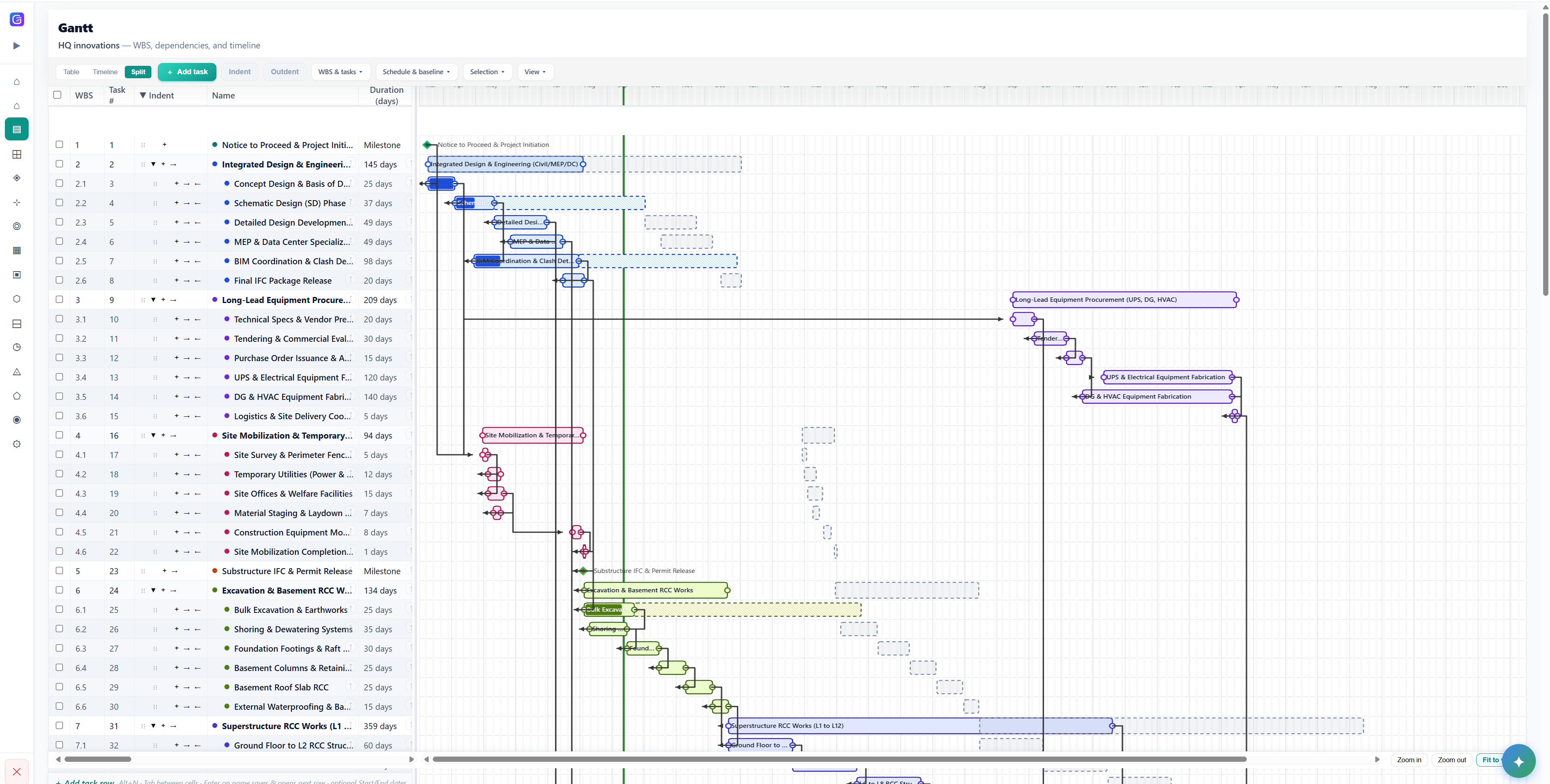
Smart Gantt

CPM discipline without the specialist queue

A dependency and calendar-aware Gantt with live critical path — readable by the PM, updatable by the site, and watched by AI.

  • Multi-phase programmes with thousands of tasks
  • Critical path recomputed from daily field data
  • Instant scenario answers, no file checkout
Why our Gantt is different →
Gantivity Gantt chart with live critical path as a Primavera P6 alternative

Who should still use P6 — and who benefits from Gantivity

Stay with P6 if you deliver mega-projects where the owner's contract mandates P6 schedules, if your planning department's workflows, claims practice, and reporting standards are built on it, or if you need its depth of resource and cost loading for contractual schedule analysis. In those environments, P6 is the right contract-schedule tool — and running Gantivity alongside it is a workable pattern: P6 as the contractual baseline, Gantivity as the daily execution system feeding real progress and early warnings.

Gantivity is the better fit for general contractors, subcontractors, owners, and PMOs who need CPM discipline without a scheduling department: teams where progress currently lives in chat, the programme is updated monthly, delays surprise everyone, and nobody can get a schedule answer without booking the planner. It's also the pragmatic choice for the many projects that are too important for a spreadsheet but could never justify P6's cost and complexity — see construction project management software for the full platform, and Gantivity vs Microsoft Project for the other common incumbent.

Current plans are on pricing, practice guides on the blog, and early access applications through contact.

Gantivity vs Primavera P6: common questions

Is Gantivity an alternative to Primavera P6?
For general contractors, subcontractors, owners, and PMOs whose pain is keeping the schedule connected to the site, yes — Gantivity covers CPM fundamentals with Gantt and critical path, and adds AI generation, daily field progress, delay prediction, and automated escalation. Organisations running mega-projects with contractual P6 requirements will often keep P6 as the contract schedule, sometimes alongside Gantivity for execution.
What is Primavera P6 genuinely good at?
P6 is the industry standard for large and mega-projects: a deep CPM engine handling very large activity networks, multi-project structures, resource and cost loading, baselines, and rigorous schedule quality analysis. Many owner contracts on major infrastructure explicitly require P6 schedules, and experienced planners have decades of accumulated practice in it.
What are the common pain points with P6?
Cost and complexity are the recurring themes: licensing and training are significant, the interface assumes a trained scheduler, and in practice the schedule becomes one specialist's file. Site teams don't interact with P6 directly, so progress reaches the schedule through manual updates on a weekly or monthly cycle, and the programme everyone else sees is an out-of-date PDF.
How does Gantivity differ from P6 in daily use?
Gantivity connects the schedule to the site: engineers file daily progress from the work face, execution signals and delay prediction update continuously, issues auto-escalate with severity and logging, and AI generates status, risk, and variance reports from live data. Any stakeholder can ask ZAI schedule questions in-channel instead of queueing behind the scheduler.
Who should still use Primavera P6?
Teams delivering mega-projects where the contract mandates P6, organisations with established planning departments deeply invested in P6 workflows, and projects requiring its depth of resource, cost, and claims-grade schedule analysis. In those environments P6 is the right contract-schedule tool — the gap Gantivity fills is between that schedule and what happens on site each day.
Is Gantivity affiliated with Oracle?
No. Gantivity is built by DashFlow Solutions and has no affiliation with Oracle. Primavera P6 is a product and trademark of Oracle Corporation, and references to it here are for factual comparison only.

Close the gap between the programme and the site

Run one live project in Gantivity — alongside P6 if you need to — and see daily progress, prediction, and escalation working within a week.